
It’s one of the most common anxieties a loving pet owner has: You manage to capture the perfect, adorable close-up of your feline friend, but realize the camera flash was on. That brief, intense burst of light, reflecting back as a ghostly green or yellow glow, immediately triggers worry. Does Camera Flash Hurt Cat’s Eyes?
Given how sensitive cat eyes are—designed to hunt and navigate in near-total darkness—it is completely reasonable to be concerned about subjecting them to a sudden, powerful flash. You want the photo, but you certainly don’t want to risk their health.
The good news is that this common concern is largely unfounded. The anatomy of a cat’s eye is built to handle far more intense light exposure than a single camera flash provides.
Is Camera Flash Dangerous for Cats?
The vast majority of standard camera flashes, including those built into smartphones and entry-level DSLR cameras, do not cause permanent damage to a cat’s eyes.
No, a standard camera flash is not physically harmful to your cat’s vision. The primary reason a cat’s eyes appear startled is due to the brief, sudden disruption of their superior night-adapted vision. A quick flash is annoying and startling, but the light energy released is simply too brief and too low-powered to create the thermal or light damage required to injure the retina.
| Factor | Cat Eyes | Human Eyes |
| Night Vision | Superior (due to Tapetum Lucidum) | Standard (no Tapetum Lucidum) |
| Pupil Dilation | Extremely fast and wide | Slower and more restricted |
| Flash Impact | Startling, temporary disorientation | Annoying, temporary spot/blindness |
| Physical Damage Risk | Negligible from a standard flash | Negligible from a standard flash |
✨ The Science Behind the Glow: Understanding the Tapetum Lucidum
To understand why the flash is harmless but produces that dramatic glowing effect, you have to look behind the pupil at a structure humans don’t have: the Tapetum Lucidum.
What is the Tapetum Lucidum?
The Tapetum Lucidum is a layer of tissue that lies directly behind the retina. Its Latin name translates roughly to “bright tapestry” or “shining layer.”
- Light Amplification: When light enters a cat’s eye in low-light conditions, not all of it is immediately absorbed by the photoreceptors (rods and cones) in the retina.
- Reflect and Recapture: The Tapetum Lucidum acts like a mirror, reflecting the unabsorbed light straight back through the retina.4 This gives the photoreceptors a second chance to absorb the light.
- Night Vision: This mechanism is what allows cats to see with up to six times greater efficiency than humans in dim light, making them exceptional nocturnal hunters.
Why Cats’ Eyes Reflect Different Colors
The famous “devil eye” or eyeshine effect is the camera flash reflecting off this Tapetum Lucidum.
- Green/Yellow: This is the most common color and is typically seen in cats with green or yellow iris colors.
- Blue/White: Cats with blue eyes (like Siamese or color-point breeds) often lack pigment in the non-tapetal area of the retina.7 When the flash hits, this lack of pigment can cause a more blueish or whitish-red reflection.
- Red-Eye Effect (Rare): In a few specific circumstances, or when the light angle is just right, the reflection may bypass the Tapetum Lucidum and instead reflect off the blood vessels in the back of the eye, producing a subtle red effect, similar to human “red-eye.”
The color of the reflection is entirely dependent on the composition of the tapetum, the eye pigment, and the angle of the light, but it has nothing to do with pain or damage.
☀️ Why a Quick Flash Isn’t Harmful (The Energy Factor)
The fear that a flash can damage a cat’s eyes often stems from a misunderstanding of the light’s intensity versus its duration.
Flash vs. Sunlight: A Crucial Comparison
Your cat’s eyes are built to protect themselves. Every time your cat glances outside on a sunny day, its pupils constrict (turn into those famous vertical slits) to protect the retina from the sun’s sustained, massive energy output.
A camera flash, on the other hand, is:
- Extremely Brief: The flash lasts only a fraction of a second (sometimes less than $1/1000^{th}$ of a second).
- Low Energy: The total light energy delivered to the retina is minimal compared to even a few seconds of continuous exposure from the sun or a high-powered lamp.
If a cat is able to handle walking out onto a sun-drenched patio without going blind, a brief, momentary camera flash is not going to overload the system. The danger only occurs when the light source is both high-powered and sustained.
Annoying vs. Damaging: The Startle Reflex
While the flash is not physically damaging, it is undeniably annoying and disorienting.
Cats’ pupils are often wide open in low-light conditions to maximize the tiny amount of available light.9 When the flash hits those fully dilated pupils, it’s akin to flipping a stadium light switch in a dark room—it causes momentary discomfort and a profound disruption of their night-adapted sight. They will often react by blinking, flinching, or darting away, not because they are in pain, but because they are startled and temporarily blinded.
The Golden Rule: If your cat appears distressed, hides, or consistently runs away when you try to use flash, respect their discomfort and stop.
🛑 What Is Dangerous: Light Sources to Avoid
While you can rest easy about the occasional smartphone flash, there are specific, intense light sources that can cause real, irreversible damage to a cat’s eyes.
1. The Real Danger of High-Power Laser Pointers
This is one of the greatest dangers a cat owner can inadvertently introduce. While playing with a low-power, standard red laser pointer is usually fine (as long as you never shine it directly into their eyes), high-powered blue or green laser pointers can be extremely dangerous.
- Sustained Energy: Unlike a flash, a laser pointer beam is continuous and focuses a tremendous amount of energy into a tiny spot.
- Retinal Burns: Shining a powerful laser pointer directly into a cat’s eye can cause permanent, severe burns on the retina in a fraction of a second, leading to permanent vision loss.
2. Prolonged Exposure to Intense Continuous Light
Holding a very powerful flashlight (like a tactical or search-and-rescue light) directly into your cat’s eyes for an extended period could potentially cause thermal damage. While most cats will run away long before any damage is done, the prolonged, high-intensity light is what poses the threat—not the momentary light pulse.
How to Take Flash Photos Without hurting Cat’s Eyes?
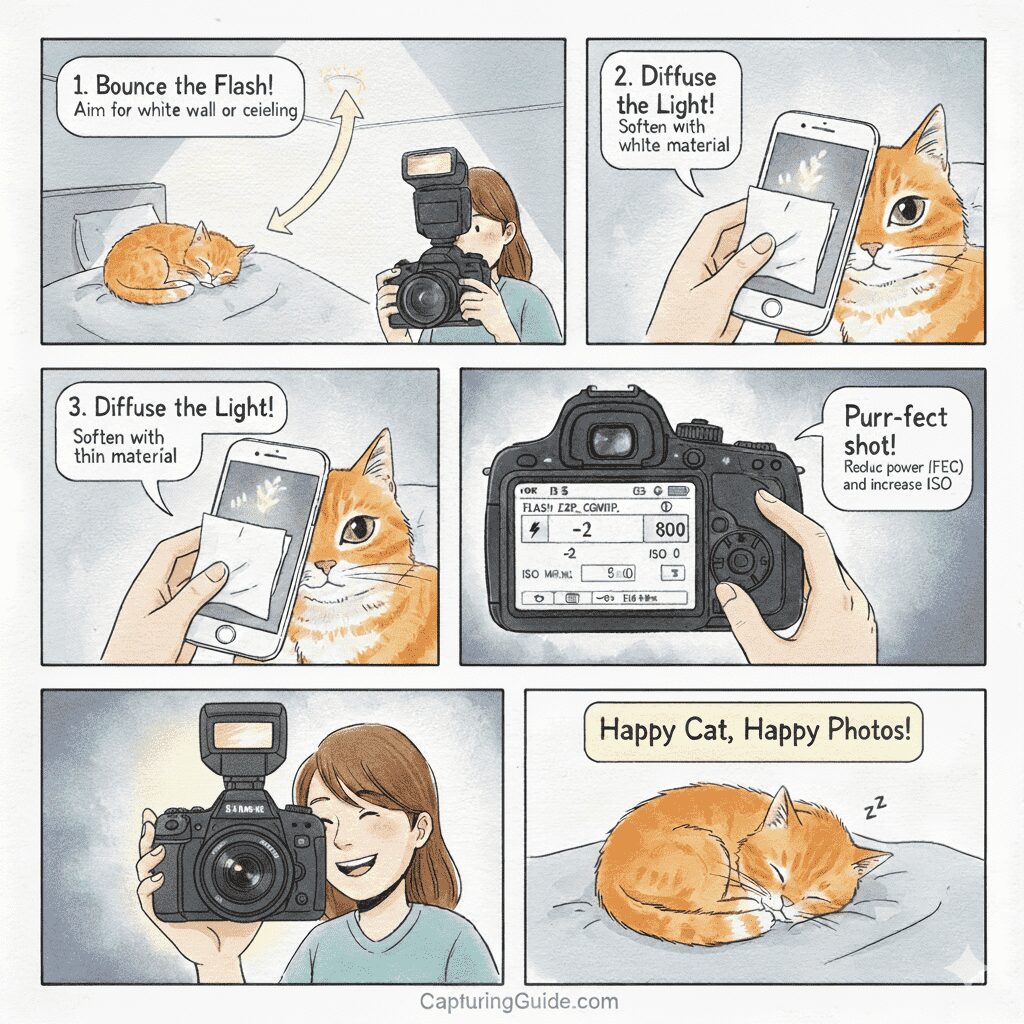
While a standard camera flash does not cause permanent retinal damage to your cat (the light burst is too brief), it is often startling and disrupts their sensitive night vision. If you want high-quality flash photography without causing discomfort, the solution is diffusion and redirection.
1. The Bounce Flash Method
Never point your flash directly at your cat. Instead, use an external flash unit (or a dedicated on-camera flash) and aim the flash head toward a large, neutral-colored surface, like a white ceiling or white wall.
- Result: The light “bounces” off the surface before reaching your cat. This creates a much softer, ambient illumination that minimizes harsh reflections (eyeshine) and drastically reduces the startling intensity, treating your cat to gentle, even lighting.
2. Diffuse the Light Source
If you must use a built-in flash, place a thin, semi-transparent material directly over the flash. This could be specialized diffusion paper, a soft box, or even a piece of thin white tissue paper (secured carefully away from the lens).
- Result: This technique spreads the light over a larger area, reducing the intensity and softening shadows. A diffused flash is less likely to cause a “deer in headlights” look and is far less annoying to your cat.
3. Adjust Camera Settings
Use your camera’s settings to reduce the power of the flash, often labeled as Flash Exposure Compensation (FEC). Lowering the power to $-1$ or $-2$ stops allows you to use a flash for fill light without overwhelming your subject’s eyes.
By focusing on bouncing and diffusing light, you can achieve professional, well-lit photos that keep your cat comfortable and calm.
⚕️ When to Worry: Signs of Cat Eye Damage
While the flash is likely safe, it is important to know the signs of actual eye problems that require a veterinary visit.
If you observe any of the following, seek professional advice, as these symptoms are related to health conditions, not photography:
- A permanent cloudy appearance over the eye.
- Persistent redness or discharge.
- Frequent squinting or pawing at the eye.
- A sudden and permanent change in the color of one or both irises.
- Dilated pupils that do not constrict even in bright light.
Conclusion
The worry over whether a camera flash harms your cat’s eyes is a testament to the depth of your bond with your pet. Rest assured, the structure of the feline eye, equipped with its powerful Tapetum Lucidum, is remarkably resilient. A split-second burst of light from your camera is startling, but it is not a threat to their permanent vision.
Keep taking those photos—just remember that the best pictures, and the happiest cat, come when you turn the flash off and use the soft, beautiful light of a sunny afternoon.